
Song: Rain
When writing about a saint, I usually turn to one or more books for research. So, be forewarned that my sole “authority” on the life of Germaine Cousin was Wikipedia.org. After poking around the Internet a bit more, I discovered conflicting accounts of her vita. Still, Germaine’s consensus story is worth telling.
Who Was Germaine?
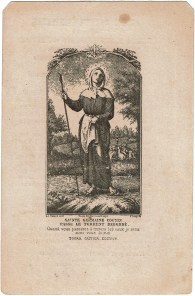
French Holy Card, 1890s
Germaine Cousin was born in 1579 in Pibrac, a small town near Toulouse in Southwestern France. At birth, one of her hands was formed differently than the other, and she suffered from scrofula, a tubercular disease.
Germaine’s family were farmers. Her mother died while she was still a baby, and her father remarried. Fearing the spread of disease, Germaine’s parents sent her out of the home to work days as a shepherdess. When Germaine returned at night, it was to sleep in the stable or on a pallet of branches in an attic.
Her family’s rejection led Germaine to deep loneliness. In order to survive emotionally, she learned patience and humility.
She also sometimes left her shepherd’s post to seek comfort at the parish church. She nurtured an inner light and sense of gratitude that honored her existence and the world around her as spiritual blessings.
Germaine’s father eventually acknowledged the family’s cruelty and invited his daughter to once again live in the house. Having long-ago accepted her lower position, however, Germaine declined.
In 1601, at age 22, Germaine allegedly died in her sleep, on the bed of twigs.
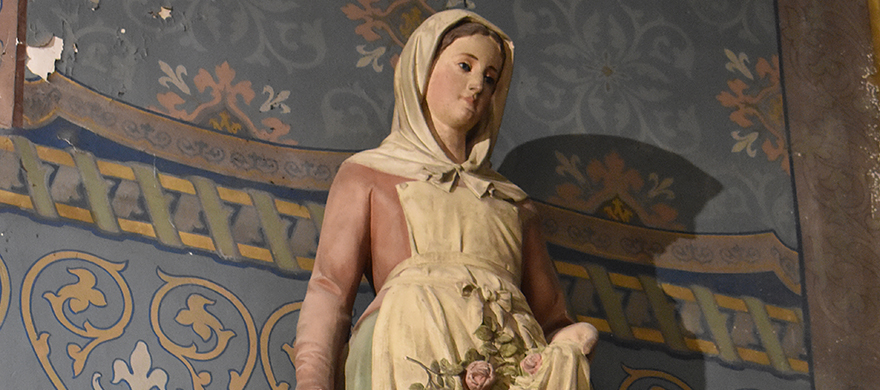
In life, Germaine possessed an ability to rise above her circumstance with grace. Following her death, fanciful legends cropped up around this trait. In one tale, she was accused of stealing bread from her family and hiding it in her apron. Germaine opened the apron, and flowers fell out as a sign of forgiveness.
Germaine’s Legacy
For much of her life, Germaine was the subject of ridicule among the Pibrac villagers. Her intense religious piety was questioned and derided. In time, the townspeople softened towards her and came to believe in her genuine goodness. After Germaine’s death, they honored her with a burial inside the parish church.
Pope Pius IX beatified Germain Cousin in 1854 and canonized her in 1857. She is the patron saint of abandoned people and those who have disabilities. Her major shrine is in Pibrac.
Germaine isn’t as widely known as some other saints. However, the essence of her story shows how the meekest among us are often also the greatest.
My Song for Germaine

Sculpture by Alexandre Falguiere, 1877, Toulouse, France (photo by Didier Descouens/Wikimedia)
In 2020, the pandemic changed the world with its tragedies and isolation. Two years later, I still felt distant from other people . . . and from myself. In August, I felt the need for a personal songwriting retreat, then headed for a cabin in rural New Carlisle, Indiana.
The cabin sat in a clearing under the open sky, between a cornfield and a wetland. I unpacked my guitar and a notebook, and also three antique holy cards I’d brought along. Each showed a different scene from the life of Germaine Cousin.
Sitting outside on the cabin’s front porch, I tried to write a song. The first attempts were clumsy and unsatisfying. The sky above me was filled with clouds. Soon it began to rain, and music poured out in response. ∗
Tagged: France, Germaine, Germaine Cousin, Germaine of Pibrac, Pibrac, Saint Germaine
 Halos Are History